Manchester City 4–1 Liverpool (01.04.2023): Guardiola’s side mastered in build-up
Manchester City clearly dominated their biggest rival in recent years and their build-up shape along with their quality in the midfield made the biggest difference, which are the areas that also paved the way for Liverpool’s decline this season.
The matches between Manchester City and Liverpool were the pinnacle of European football until just a year ago. The two teams, the usual candidates for the championship, used to determine the tactical trends, as well. Manchester City, despite being behind Arsenal in the league table this season, continue in the same way. Liverpool on the other hand, who also have some problems in their squad structure, fell far behind their rivals this year.
The most striking point in City’s squad to face Liverpool was Erling Haaland’s absence due to injury, who was replaced by the World Cup winner Julián Álvarez. Guardiola’s choice of fullbacks was Stones and Aké. Klopp, on the other hand, started Elliott with Henderson in the midfield and put Jota on the left side of the attack, benching Darwin Núñez.
As the 4–1 result of the game suggests, Manchester City dominated Liverpool in every aspect but their build-up structure with Rodri and Stones’ crucial contribution, was unmanageable for Klopp’s side.
City’s superiority in build-up and Liverpool’s pressing
Guardiola preferred his favored 3–2–5 line-up in the build-up phase against Liverpool’s 4–2–4 pressing, which Klopp especially used at the beginning of the game. This structure, perfectly accompanied by flawless positioning and timing of City players, was the largest shareholder in City’s dominance as the home side was easily able to find an extra player thanks to this systematic advantage.
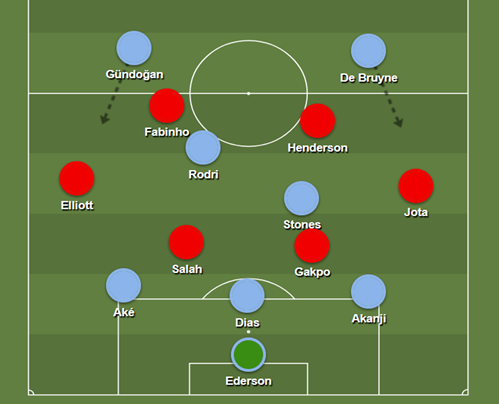
At this phase; Akanji, Dias, and Aké formed City’s back three, Stones and Rodri formed the double pivot. Against Liverpool’s two center-forwards, City usually started the game over Dias and the Portuguese defender triggered the Reds’ pressing by keeping the ball a bit longer and delaying the game. (There were also some instances in which Ederson acted like a left center-back.) After Liverpool’s forwards pressed Dias; Stones and Rodri were able to get the ball in a better situation. When this happened, Liverpool’s midfield narrowed down from the wings and went out of shape.
Stones and Rodri were the most crucial parts of City’s build-up and the duo played a perfect game in terms of their timing and positioning. Despite forming a double pivot, they positioned at different heights: when one positioned deeper, the other and mostly Gündoğan were able to make the third man principle work and made the transition.
Rodri also had an important role in manipulating Liverpool’s pressing structure as the Spanish midfielder for example sometimes positioned himself between the center-backs and dragged one of Liverpool’s two forwards, which enabled Stones to get the ball unmarked. Whilst Liverpool’s midfield trio attempted 97 passes and completed 86 of them; Rodri himself attempted the same number of passes and completed 92 of them. All these resulted in City’s dominance in the midfield.
Gündoğan, De Bruyne and City’s superiority over the wings
In addition to the impressive performances of Rodri and Stones; City’s two attacking midfielders, De Bruyne and Gündoğan, were also vital with their positioning in City’s build-up play. When Rodri, Stones, or Aké got the ball; Gündoğan and De Bruyne often positioned themselves in deep wider areas at the right time and their contribution worked perfectly to surpass Liverpool’s press.
After getting the ball, City’s creative duo mostly targeted Grealish and Mahrez, who played successfully one on one’s with Alexander-Arnold and Robertson. De Bruyne and Gündoğan were also very effective in City’s attack, positioning at halfspaces and bringing extra creativity.
City’s 4–2–3–1 pressing
Despite not being as decisive as their build-up structure, City’s pressing was also quite effective against Liverpool. Guardiola’s side pressed in a 4–2–3–1 structure, with Mahrez, De Bruyne, Grealish, and Álvarez up front.
City already knew that Liverpool’s biggest threat in build-up was their fullbacks, due to their lack of quality in the midfield. Therefore, City’s Mahrez and Grealish usually blocked the passing lines to Alexander-Arnold and Robertson with cover shadow, which substantially limited the away side’s build-up plan.
However, in some instances, City’s pressing looked too aggressive as their fullbacks and Gündoğan were always ready to take part in the pressing, which was also seen in Liverpool’s goal.
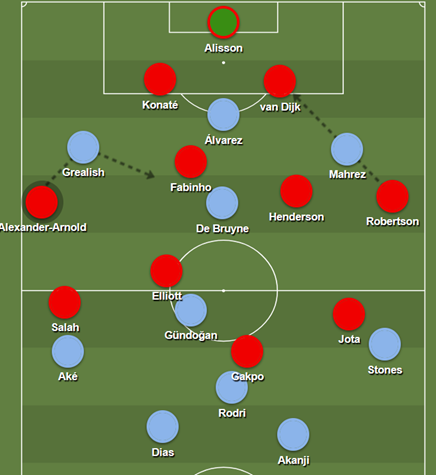
As the illustration above shows, Alisson also took part in Liverpool’s build-up. When this was accompanied by Fabinho positioning himself near the defensive line, Grealish tried to press him and it left Alexander-Arnold unmarked. When the English fullback got the ball, Aké moved upwards to press him. On the right side, Stones was also marking Robertson. After Trent’s long ball toward Jota, City only had two center-backs and Rodri behind. Before a crucial game against Tuchel’s Bayern München in the Champions League, City’s ‘too aggressive’ high pressing and rest defense structure left some question marks.
Concerning that, choosing Walker over Stones would be better for Manchester City in terms of defensive transitions. However, Walker would not bring the technical quality that Stones does, who had eighty touches and 67 completed passes.
Guardiola’s side once again proved that they can dominate a pressing side with their build-up structure, in which Stones, Dias, and Rodri played a crucial role. When it comes to attacking, Grealish and Álvarez were also very effective, alongside De Bruyne and Gündoğan.
On the other hand, things are far from being promising for Liverpool. They have problems that do not seem possible to be solved within their current squad. The best possible ending to this season would be finishing in the top four and strengthening their squad with new players

Yorumlar
Yorum Gönder